As global F-Gas Regulation requirements and REACH (Registration, Evaluation, Authorisation and Restriction of Chemicals) obligations continue to tighten, refrigerant selection is becoming a strategic decision rather than a purely technical one. These regulations influence not only system efficiency, but also long-term compliance, sustainability, and product lifecycle planning.
Within Clivet’s product strategy, R1234ze has emerged as the preferred choice across chillers and heat pumps, offering strong efficiency, low environmental impact, and long-term regulatory security compared with R1233zd.
Performance and Efficiency
R1234ze operates at slightly higher pressure levels than R1233zd, allowing smaller, more efficient compressor designs. This translates to:
Compact unit footprints, saving valuable plantroom space.
Simpler service and installation, due to smaller component sizes.
Improved Seasonal COP and IPLV when operating within the typical 5–10 °C chilled-water range.
These advantages make R1234ze an excellent fit for scroll, screw and magnetic bearing chillers configurations where flexibility, efficiency, and space optimisation are key.
Regulatory and Environmental Context
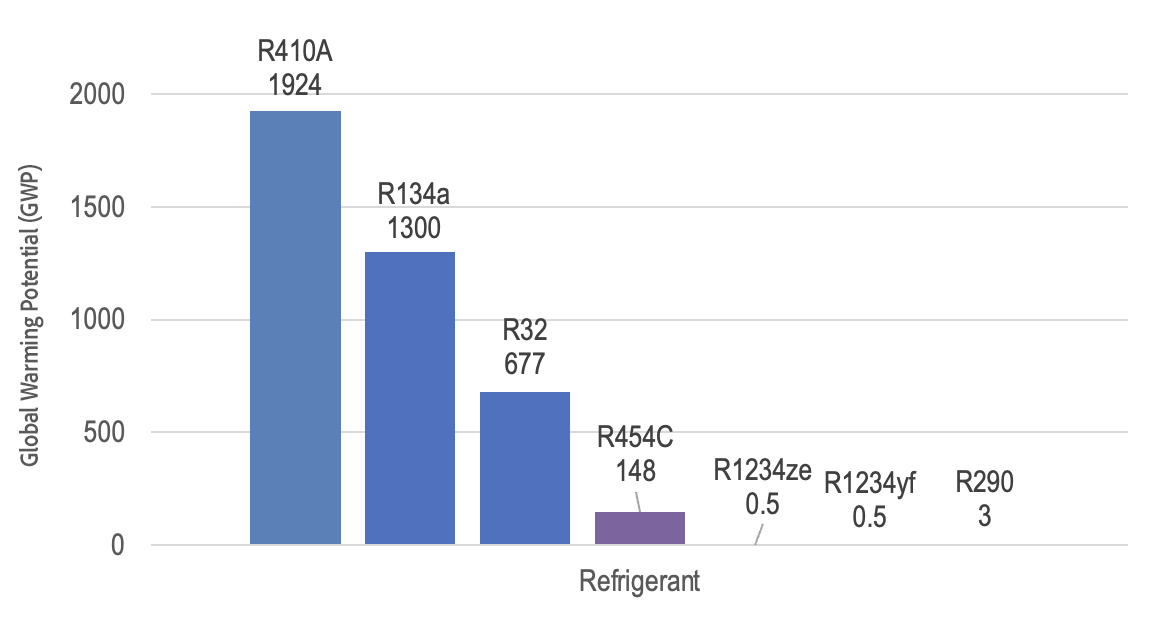
The chart below compares the Global Warming Potential (GWP) of commonly used refrigerants under the EU F-Gas Regulation, highlighting the shift toward ultra-low-GWP alternatives such as R1234ze.
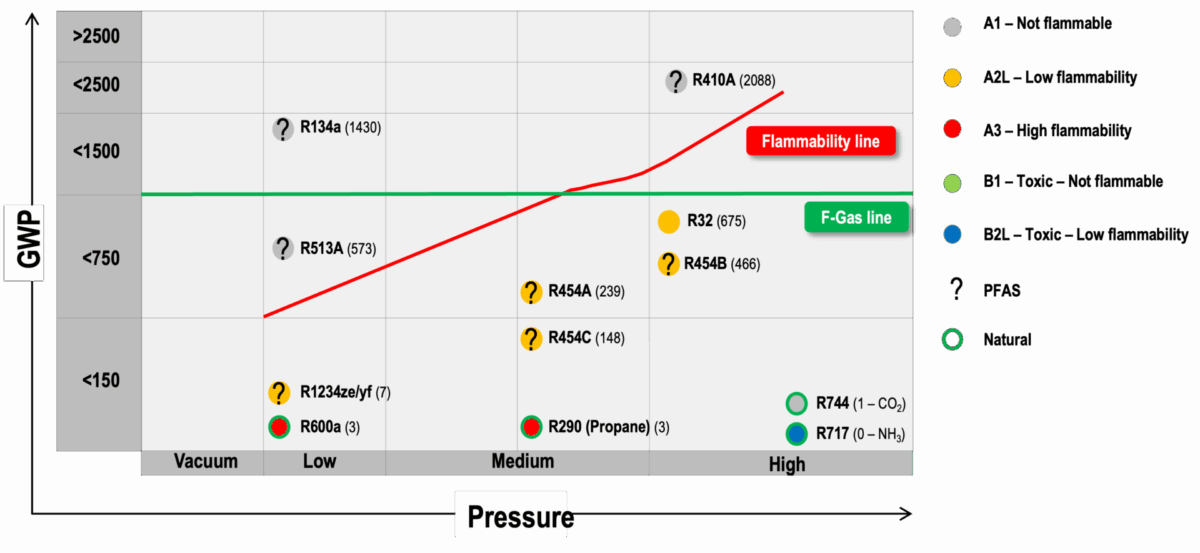
F-Gas Regulation: Refers to environmental rules that prohibit the use of refrigerants that contain fluorinated greenhouse gases (F-gases). There are bans or controls on these refrigerants based on their CO2 equipment content (GWP).
GWP = Global Warming Potential, is a measure of how much heat a greenhouse gas traps in theatmosphere up to a specific time horizon, relative to CO2
Reach Regulation on PFAS
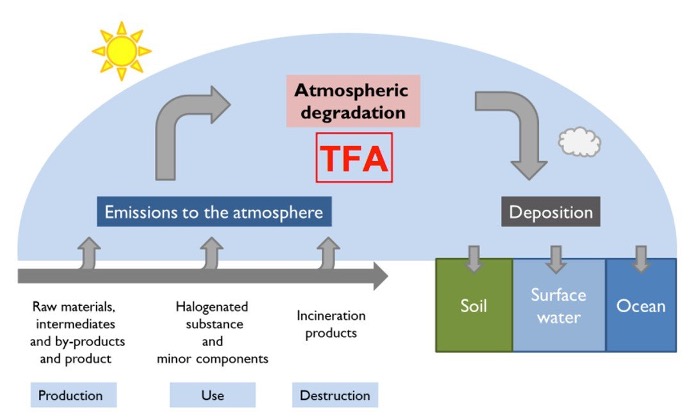
Under the REACH Regulation, increasing attention is being placed on PFAS (per- and polyfluoroalkyl substances) due to their persistence in the environment. Some fluorinated refrigerants can degrade into by-products such as trifluoroacetic acid (TFA), which accumulates in water systems and is difficult to remove.
The diagram below illustrates the atmospheric degradation pathway of certain fluorinated refrigerants and how PFAS by-products such as TFA can be formed and deposited into soil and water systems.
Source: Clivet internal technical presentation
Application Differences
R1233zd is traditionally used in centrifugal chillers, which serve very large capacity applications. R1234ze, however, suits screw and scroll chillers, making it ideal for modular and multi-combination systems such as Clivet’s SpinChiller 4, ScrewLine 4-i, and MagBoost Magnetic Bearing Chillers ranges. These configurations are commonly applied in universities, hospitals, and data centres where efficiency and footprint optimisation are critical
Sustainability and Future Compliance
Clivet’s refrigerant roadmap combines R1234ze and R290 (propane) to achieve both sustainability and performance goals. This approach aligns with:
EU F-Gas phase-down targets,
REACH PFAS reduction initiatives, and
The company’s broader aim of delivering energy-efficient, low-impact HVAC solutions.
With upcoming bans and carbon-equivalent quotas tightening, R1234ze’s extremely low GWP and partial PFAS-free composition position it as the most future-proof choice for long-term operations.
Summary
R1234ze offers advantages in environmental impact, system efficiency, and compact system design, making it well suited to modern screw, scroll, and magnetic bearing chillers where environmentally-friendly operation and reduced system footprint are important.
R1233zd remains a strong and appropriate choice for large centrifugal chiller applications, where its pressure characteristics, stability, and established use support high-capacity systems designed for continuous, long-term operation.
Ultimately, both refrigerants deliver strong performance, with the optimal selection depending on system type, project scale, and regulatory objectives.
2min readChoosing the right refrigerant is critical for balancing performance, efficiency, and long-term sustainability. The table below compares R1234ze and R1233zd—two low-GWP refrigerants commonly used in…
3min readEnsuring the optimal performance and longevity of a Centrifugal Chiller, equipped with a Toshiba motor, is critical. This diagnostic report, utilizing our PDMA MCE/Emax™ tool,…
2min readThe Promise: Revolutionise temperature and efficiency standards. The Focus: Innovation and sustainability. The Features: A multitude; do read on. The new THUNDER heat pumps boast…